
A Surprise
And an Honorable Mention at the German National Library

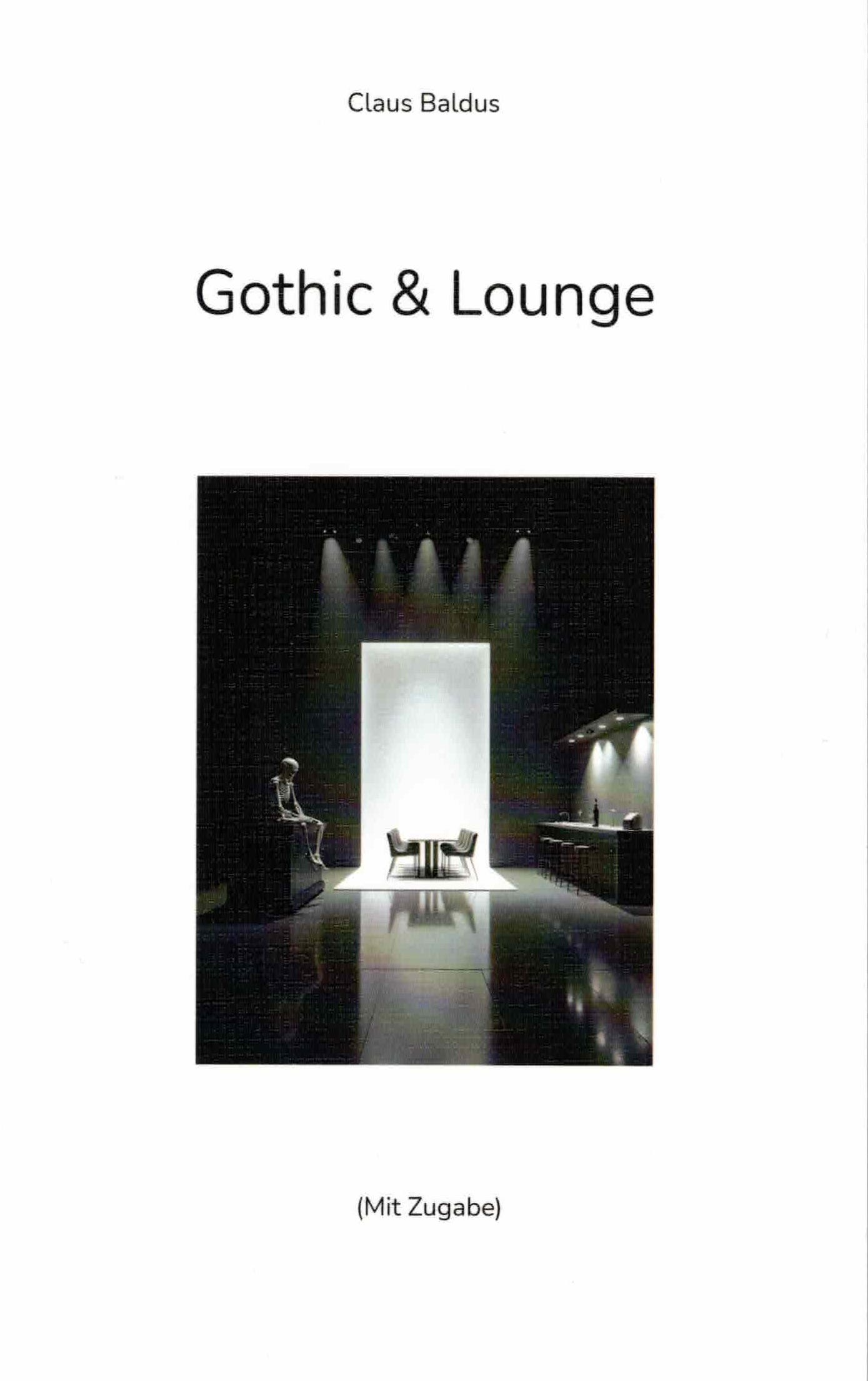
My dear German-Croatian friend Adrian S. Kostré in Berlin contacted me late last year, asking me to translate a piece he had written in collaboration for a book project destined to be registered with the Deutsche Nationalbibliothek. He said this was an accomplishment I shouldn’t ignore because I would also be listed as a contributor. I’ve translated for Adrian in the past, including his poetry, and would have done this for him anyway.
He contacted me more recently, saying he sent me a book, but didn’t mention which one. I assumed he had published another of his books. To be honest, I forgot entirely about the book to be registered in Germany’s National Library. Imagine my surprise when I opened the package this week and discovered not another book by Adrian, but Gothic & Lounge (Mit Zugabe) — (With Encore), which Adrian’s friend and collaborator, German author Claus Baldus, suggested they should produce together
Gothic & Lounge is a small book of just 102 pages with a small format of just 19 x 12 cm (7.5 x 4.7 in) but intriguing and challenging in different ways. The book is illustrated with AI-generated b&w and color photos that appropriately accompany each section. Claus and Adrian both signed my copy of the book with a brief inscription Für Fred and enclosed a postcard of the front cover, which I could use as a bookmark.
Claus is a well-known scholar of architectural theory and cultural history. Among his many interests, Claus also likes to question cultural and boundaries, including relationships, in creative and sometimes controversial ways. He begins the book with a short essay on friendship, “Freude an Differenz — Eine Freundschaft” (Joy in Difference — A Friendship), in this case describing his decades-long friendship with Adrian.
Following the introduction, Claus presents the reader with a performance piece divided into three scenes, “GOTHIC — Wir Sprachen mit Godot” (Gothic — We spoke with Godot), ending with a explanatory background piece called POSTSKRIPTUM.
Adrian provides the reader with a preface in German titled “Gothickroatisch,” preceding his translation of the “Gothic” performance text into Croatian. In his preface, he recalls the late 1960s and 1970s as one of the best times in Croatian theater during what he calls the “Croatian Spring” when the country began its transition from the Socialist Federal Republic of Yugoslavia to its eventual autonomy in 1992.
Adrian’s piece, “Das Licht am Ende des Tunnels,” and my translation “The Light at the End of the Tunnel” precedes another short experiment performance piece by Claus called “LOUNGE — Ein Affront,” which Claus and Adrian decided should remain in German and not be translated at all.
For what it’s worth, my name, with a short bio, follows those of Claus and Adrian, and appears on p. 99.
N.B. I’ve known Adrian for more than 40 years. When I first met him, I was already in my early 30s and living briefly in Hamburg. Adrian was in his early 20s, and had just begun his career as a writer and editor at Sender Freies Berlin (Radio Free Berlin), which became rbb (Radio Berlin Brandenburg) after the wall came down. Although I returned to the State shortly after meeting him, we’ve remained in contact ever since.
Bravo, Mr. Fullerton! Another golden addition to your growing legacy. May your day be full of writable wonder 😊LG
Congrats to you, Claus and Adrian. So interesting to be part of an international team!